
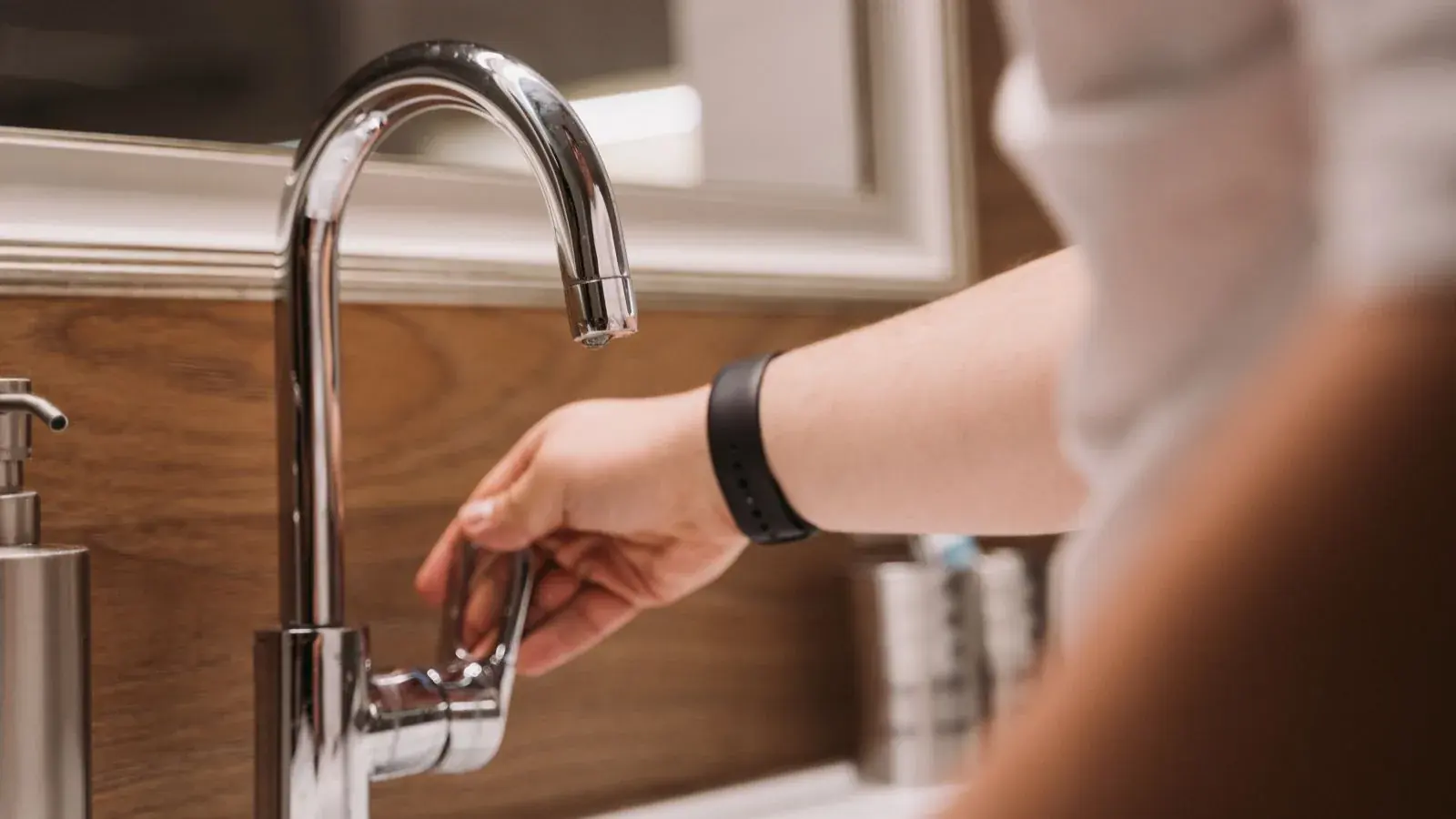
A kitchen faucet works harder than any other fixture in the house. It runs dozens of times a day, takes hot water, mineral scale and the occasional bump from a pot. It is no surprise that most of them start leaking at some point.
This guide shows how to find where yours leaks and what the repair involves. If you would rather have it done, our faucet repair team handles it, and we answer 24/7 if water will not shut off.
Start by finding where it leaks
Dry the faucet and sink with a towel and run the water. Watch each spot in turn. A drip from the spout when the faucet is off means a worn cartridge, washer or seat. Water around the handle means worn O-rings or packing. Water at the base of the faucet means a failed seal or a loose mounting.
Water under the sink is a separate issue. Check the supply lines and the stop valves with a dry paper towel, and wipe the drain trap and connections.
Faucet style and what wears out
The style tells you which part to buy.
| Style | How to recognize it | Part that wears |
|---|---|---|
| Compression | Two handles you turn several times | Rubber washer and seat |
| Cartridge | One handle or two, smooth action | Cartridge or O-rings |
| Ball | Single handle over a ball joint | Springs and seals |
| Ceramic disc | Single handle, smooth lift and turn | Disc cartridge |
| Pull-down | Spray head on a hose | Hose, spray head or diverter |
The basic repair in six steps
Close both stop valves under the sink and open the faucet to release pressure. Plug the drain so a small screw cannot fall in. Remove the handle by prying off the cap and loosening the set screw, then remove the retaining nut and lift out the cartridge or stem.
Take the old part to a hardware store and match it exactly, since many cartridges look alike but differ by a few millimeters. Install the new part, replace the O-rings, reassemble and open the stop valves slowly.
When the aerator is the real problem
If the water sprays sideways or pressure is weak but nothing drips, unscrew the aerator at the spout tip. Mineral deposits clog the screen, and a soak in vinegar usually clears it. Rinse, reinstall and check flow.
A clogged aerator is a free fix, and it is worth checking before you replace a cartridge.
Repair or replace
If the finish is worn, the faucet is more than fifteen years old or parts are no longer made, replacement is usually the better choice. A modern faucet uses parts that are widely available, and it can be a good moment to upgrade the stop valves too.
If you plan a kitchen remodel, our plumbing installation team coordinates the faucet, the supply lines and the drain so everything is replaced once.
Choosing a replacement faucet that lasts
If you decide to replace the faucet, look for solid brass bodies, ceramic disc cartridges and a finish with a long warranty. Check that the new faucet matches your sink's hole count, and that supply lines and a deck plate are included if you need them. A pull-down sprayer is convenient, but its hose is one more part that can wear.
Buy from a maker that stocks cartridges and parts for years, since a beautiful faucet with no available parts is a repair problem in disguise. Keep the box and the manual, which list the cartridge number you will need later.
Common mistakes that turn a drip into a flood
Over-tightening a packing nut, forcing a stuck handle or cranking a stop valve that has not been moved in years can all crack a part or break a seal. Forced old valves may leak around the stem or fail to close again.
If any part will not move with firm, steady pressure, stop. Close the main water valve instead, and call a plumber. A repair that costs a service visit is far cheaper than a flooded kitchen.
Water in Hamden and faucet wear
Hamden is in the service area of the South Central Connecticut Regional Water Authority. Its annual report lists lead at 0.0006 ppm and copper at 0.32 ppm at the 90th percentile from 2023 sampling, both well under the federal action levels, and it states no hardness figure.
Without a published number, the best guide is your own faucet. White crust on the aerator suggests scale, and it tells you how often to clean or replace cartridges. If you have older brass supply lines, our team checks them at the same visit. Replacement fixtures must meet the plumbing code, and Connecticut's 2022 State Building Code is based on the 2021 International Plumbing Code (IPC).
When to stop and call a plumber
Call if water will not shut off, if a stop valve will not close, if the leak is inside the wall or if you see corrosion on the supply connections. Those are the cases where a do-it-yourself repair turns into a flood.
We serve North Haven and Wallingford as well as Hamden, and we dispatch around the clock when a faucet will not stop.
Call us and we will guide you through the shutoff.
Local questions answered
Close the stop valves under the sink. If they will not turn, close the main water valve and call us.
A screwdriver, an adjustable wrench and a hex key cover most repairs. Some faucets need a puller for the cartridge.
Yes. Scale wears seals and clogs aerators, and cleaning them helps.
Usually yes. Old lines can fail and are inexpensive to replace at the same time.
Yes. We check that the fixture fits your sink and supply connections.