
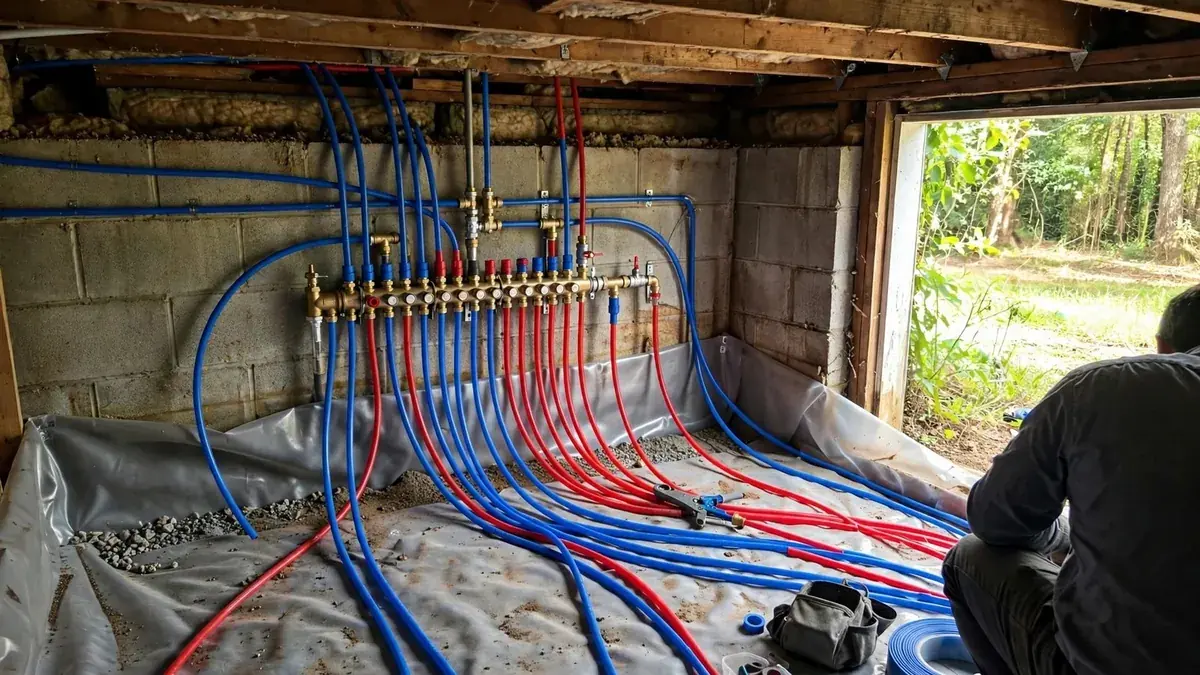
Whole-house repiping in Hamden, CT replaces the water supply piping throughout a home. It makes sense when pipes leak repeatedly, when water runs brown or weak because of corrosion inside, or when the material itself is known to fail, such as galvanized steel at the end of its life or polybutylene from a particular era of construction.
Repiping is a planned project, and we treat it that way. We give you a clear scope, a plan for protecting your home, and an honest view of whether a smaller repair would solve the problem. If a pipe has just burst, our burst pipe repair team handles the emergency first.
Signs your pipes may be due
The pattern matters more than any single event. One pinhole leak in a copper pipe is a repair. Three in two years is a signal. Rust-colored water at first draw, falling pressure that gets worse over time, and visible green corrosion at joints all point toward a system that is wearing out.
Galvanized steel corrodes from the inside, narrowing the pipe until pressure drops. Polybutylene, installed in many homes from roughly the late 1970s through the mid-1990s, has a record of failing at fittings. If you are not sure what you have, we can identify it on a short visit.
Pipe materials compared
The right material depends on the house, the budget and the water.
| Material | Strengths | Considerations |
|---|---|---|
| PEX | Flexible, fewer fittings, resists freeze splitting better than rigid pipe | Not for exposed sunlight, needs proper support |
| Copper | Long track record, durable, fire resistant | Higher material cost, can pit in aggressive water |
| CPVC | Affordable, easy to work with | Brittle in cold, sensitive to some chemicals |
| Galvanized (existing) | Present in many older homes | Corrodes inside, and is the usual reason for repiping |
What the project looks like in a lived-in house
We plan around access. Basements, crawlspaces and attics let us run new pipe with minimal wall opening. Where walls must be opened, we choose small, strategic openings and plan the drywall patch. Most homeowners can stay in the house, with a few planned periods without water.
We sequence the work so the house is not without water for the whole project. New lines are connected, tested under pressure, and then the old lines are abandoned or removed.
Older neighborhoods and what we expect to find
Houses in neighborhoods such as Highwood and Spring Glen were built across many decades, and plumbing in any older house may have been modified more than once. Where several materials share a house, a repiping job is a chance to bring them all to one system.
That is a pattern we check for, not a claim about any specific house. A visit lets us see what you actually have.
Code, permits and inspection
Plumbing work in Connecticut falls under the 2022 Connecticut State Building Code, which is based on the 2021 International Plumbing Code. Permit rules for repiping vary, so ask the Hamden building department and check the town's permit portal for how a permit is requested.
We plan for inspection access, and we pressure test the new system before closing walls, so problems are found while they are easy to fix.
Repair now or repipe later
A single failed section in an otherwise sound system is a repair, and repiping is not always the answer. Our leak detection work can find and isolate the problem pipe, and you can decide from there.
If you are planning a kitchen or bathroom remodel, repiping at the same time is easier and cheaper than opening the same walls twice. Tell us about your plans when you call.
What goes into a repiping estimate
You get a clear price before work starts.
Insurance generally does not cover repiping as a maintenance project, though water damage from a sudden failure may be covered. Ask your carrier. Call (203) 720-6269 to plan an estimate.
Code and inspection for new supply lines
Replacement supply piping is regulated. The 2022 Connecticut State Building Code is based on the 2021 International Plumbing Code (IPC), which covers approved materials, sizing and testing. Permit and inspection rules vary, so ask the Hamden Permits and Licensing Center, and we plan the work so inspectors can see the piping before walls close.
Call and tell us what is leaking or what your pipes are made of.
Repiping questions in Hamden
Many homes take a few days, depending on size, access and finish work.
Usually yes. We plan the work so you have water for most of each day.
Both work well. PEX is flexible and quicker to install, and copper has a long track record. We talk through the trade-offs for your house.
Permit rules vary, so ask the Hamden building department. We can help you gather the details.
We make small access openings and can patch them, or we can coordinate with your finish contractor.
Yes. See Wallingford and New Haven for details.