Hot water at the shower and the bathroom sink but not at the kitchen sink is a frustrating puzzle. The tankless heater is clearly working, so the cause is somewhere between the heater and that one faucet.
This guide walks through the likely causes in order, from a clogged aerator to a crossed connection. If the whole house has no hot water, our tankless water heater page covers heater faults.
Start with the faucet
Check whether the faucet gives any hot water at all. Open it fully on the hot side and wait a minute. If the water stays cold, the cartridge or the supply may be the culprit. If the water is warm but weak, the aerator may be clogged.
Unscrew the aerator and look at the screen. Mineral deposits and debris collect there, and a soak in vinegar clears most of it. A failed cartridge in a single-handle faucet can also block hot water, which is a job for our faucet repair team.
Causes in the order we check them
Work from the simplest to the most involved.
| Cause | How to spot it | Fix |
|---|---|---|
| Clogged aerator | Weak flow, spray goes sideways | Clean or replace the aerator |
| Closed or partly closed stop valve | Hot line under the sink feels cool | Open the hot stop valve fully |
| Failed cartridge | Cold only at the mixed setting | Replace the cartridge |
| Kinked or blocked supply line | No flow when disconnected | Replace the supply line |
| Long run and low flow | Hot water arrives late at the kitchen | Add a recirculation line or a point-of-use heater |
| Crossed connection | Hot and cold swapped after a repair | Correct the connection |
The minimum flow problem
Tankless heaters need a minimum flow of water to fire. If the kitchen faucet is turned low, the flow may fall below that threshold, and the heater does not turn on. A faucet with a low-flow aerator can make the problem worse.
Try opening the kitchen tap fully. If the water heats up, the flow was too low. Cleaning the aerator or replacing a restrictive one often fixes it.
Cold water sandwich and the long run
A tankless unit may deliver a burst of hot water, a short blast of cold and then hot again, known as the cold water sandwich. It happens when the unit shuts off and restarts between short uses. The kitchen sink, with its short bursts of use, is where people notice it.
If the kitchen is far from the heater, the wait for hot water is longer and wastes water. A recirculation pump or a small point-of-use heater under the sink shortens the wait.
Is the heater itself involved
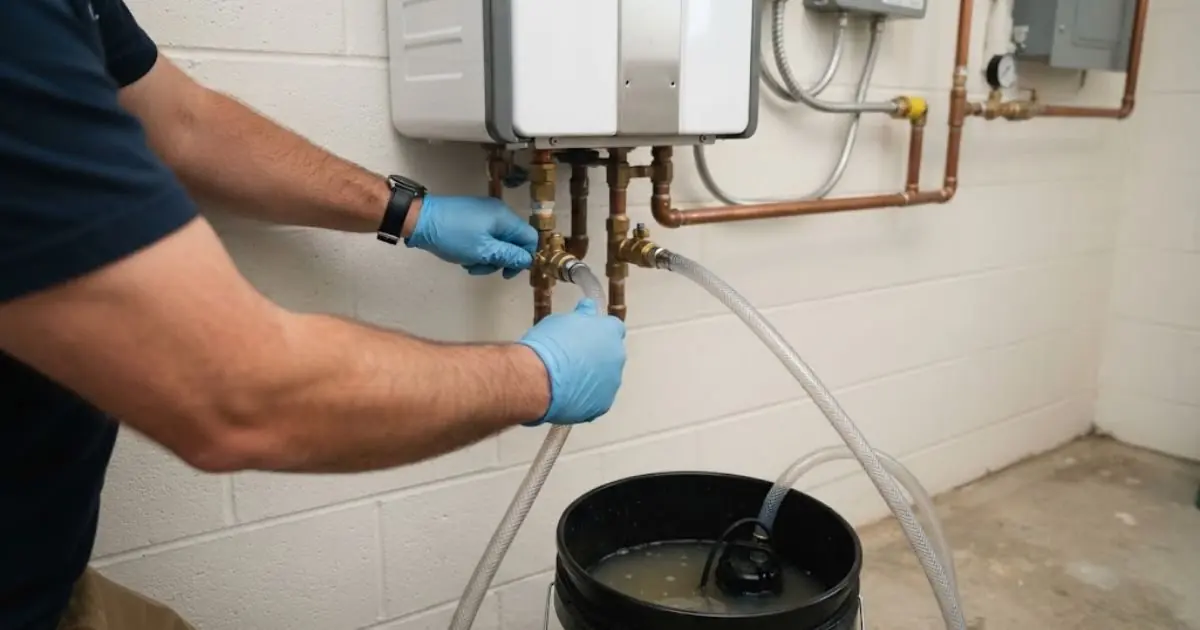
If other fixtures lose hot water at times, or the unit shows an error code, the heater needs attention. Common causes include a clogged inlet filter, scale buildup on the heat exchanger and a vent or gas supply issue. An annual flush prevents most scale problems.
We never recommend bypassing a safety device or removing a vent pipe. If you smell gas, leave the home and call the gas utility or 911 first.
A quick checklist before you call
Try each hot tap in the house and note which ones work. Check the stop valve under the kitchen sink, remove and clean the aerator and look for a kinked supply line. Note whether the problem is cold water only, weak water or a long delay, because each points to a different cause.
If the unit shows an error code, write it down. Tell us the heater's make and model and when it was last flushed. With those details, we can usually tell you the likely cause before we arrive, and we bring the right parts.
Hamden water and tankless units
The South Central Connecticut Regional Water Authority supplies Hamden, and its annual report does not publish a hardness number. Scale in aerators and heat exchangers is one way to see what your water does, and the authority at 203-562-4020 can send its latest water quality report.
Plumbing work in Connecticut falls under the 2022 State Building Code, based on the 2021 International Plumbing Code (IPC). Permit rules vary, so ask the Hamden Permits and Licensing Center if the fix involves new piping.
When to call a plumber
Call if the stop valve will not turn, if you find a leak under the sink or if the problem follows you from fixture to fixture. A faucet that will not shut off is an emergency, and we answer 24/7.
We serve Wallingford and North Haven as well as Hamden.
Call us and tell us what the faucet does.
Local questions answered
A clogged aerator, a closed stop valve or a failed cartridge are the most common causes.
Yes. Many units need a minimum flow to fire, and a very low tap setting can stay below it.
A burst of cold water between two bursts of hot, caused by the unit shutting off and restarting.
Yes. It keeps hot water near the fixtures and shortens the wait.
Many manufacturers call for an annual flush. Check your manual.