
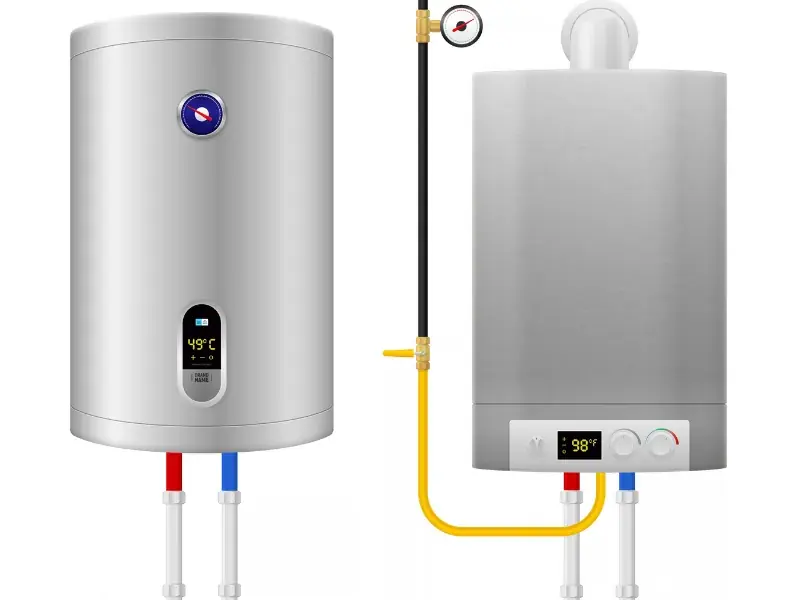
A tankless water heater heats water as it flows, so there is no tank of stored hot water waiting to run out. A direct vent model is a gas unit that does not use room air for combustion. Instead, it draws air from outside through one pipe and pushes exhaust gases out through another, which keeps the combustion sealed from the living space.
Many Hamden homeowners ask about direct vent units when they replace an old tank in a basement or a closet. This guide explains how the system works, what installation involves and where our tankless water heater page can help you decide.
What direct vent means in plain terms
Older gas water heaters use air from the room around them and send exhaust up a chimney or a vent by natural draft. A direct vent unit is a sealed system. A fan pulls outside air in and pushes exhaust out, so it does not depend on the draft of a chimney and it does not take air from the house.
Most direct vent units use either two separate pipes or a single concentric pipe with one inside the other. Both end at an outside wall or roof termination that must sit at the clearances in the manufacturer's instructions.
Direct vent compared with other venting types
The venting type decides where the unit can go and what the installation involves.
| Venting type | How it breathes | What to expect |
|---|---|---|
| Natural draft | Room air in, chimney or vent out | Needs a working chimney, older tank heaters |
| Power vent | Room air in, fan pushes exhaust out | Flexible vent runs, uses room air |
| Direct vent | Outside air in, sealed exhaust out | Two pipes or a concentric pipe, better for tight spaces |
| Electric | No combustion | No vent, but needs a large electrical supply |
What your house needs
Switching to a tankless unit is more than swapping one heater for another. A gas unit needs the right gas line size for its input, a condensate drain because high-efficiency models produce acidic condensate and a proper vent route to the outside. Water supply lines may need new valves so the unit can be flushed.
Some homes also need a larger gas meter or regulator. The utility decides that, so we raise it at the start of the project, not after the old heater has already come out.
Hot water that feels the same everywhere
A tankless unit produces a steady stream of hot water as long as it can keep up with the flow. If you run a shower, a dishwasher and a washing machine at the same time, a small unit may struggle. Sizing depends on the number of fixtures you use at once and on the temperature rise you need, which is the difference between your incoming water and your target.
Incoming water is colder in a Connecticut winter, so a unit that is fine in August may be tested in January. A good installer sizes it for the cold months.
Why tankless units need flushing
Minerals in the water gradually coat the heat exchanger. Annual flushing with a descaling solution keeps the unit efficient and extends its life. Skipping it is the most common reason a tankless unit loses capacity or throws error codes.
If you want the water-heater basics before you decide, our water heater installation page explains how we plan the swap, and our flush and descale service is described on the tankless page.
The no-hot-water call and what to do first
If a tankless unit shows an error code, check the display and the manufacturer's manual first. Common causes include a closed gas valve, a blocked vent termination, a clogged inlet filter or a tripped breaker for the fan. Never remove a vent pipe or bypass a safety device.
If you smell gas, leave the home and call the gas utility or 911 before anything else. We handle the plumbing side after the area is safe.
Water, code and permits in Hamden
Plumbing work in Connecticut falls under the 2022 State Building Code, which is based on the 2021 International Plumbing Code (IPC). Gas piping and venting have their own rules, and permit rules vary, so ask the Hamden Permits and Licensing Center what your project needs.
The South Central Connecticut Regional Water Authority supplies Hamden, and its annual report does not publish a hardness figure. That is a good reason to ask the authority, or test your tap, before you decide how often to flush a tankless unit.
Is direct vent tankless right for your home
It works well when you want to free up floor space, when the existing chimney is unusable or when your household draws a lot of hot water in a day. It is a poor match when your gas line cannot be upsized or when there is no route for the vent to the outside.
We serve North Haven and Woodbridge as well as Hamden. In Woodbridge, tell us if the property is on a well, since water chemistry affects the heat exchanger.
Call us and describe your current heater.
Local questions answered
No. It uses sealed pipes to the outside, so it does not need a chimney.
Many manufacturers call for an annual flush. Check your model's manual and your water conditions.
Gas, venting and permits make it a job for a licensed plumber.
The line may need to be upsized, and we raise it with the utility at the start.
Most use electricity for the fan and controls, so they stop when the power fails unless you add a backup.